
NCJO | Pānui
Welcome to the second edition of the NCJO pānui.

Firstly, a thank you to those who have filled out the Civil Justice Initiatives Snapshot. This helps NCJO maintain a live picture of what’s happening across the civil justice landscape, track progress against the Waypoints, and identify gaps, opportunities, and areas for collaboration. If you haven’t had a chance to complete the Snapshot yet, or have new initiatives to add, the link is available here. We’re keen to hear about initiatives of all sizes. It’s a short, three‑question form, and there’s also space to share any issues, patterns, or pressure points you’re seeing.
In this issue, we’re pleased to announce the launch of our first NCJO network groups. These are smaller, issue‑focused groups that bring together people from across the sector to connect, share insights, and work collaboratively.
We’re also sharing recently released research from FinCap and Consumer NZ, highlighting a podcast series on trauma-informed legal practice, and circulating the consultation opportunity on the employment dispute system. To support engagement with the consultation, we are hosting a webinar with Dr Dawn Duncan, which will explore how the system is working and highlight insights to support those preparing submissions.
As always, please get in touch if you have events, professional development opportunities, new research, or anything else you think would be useful to share.
Take care as the colder months set in!
Associate Professor Bridgette Toy-Cronin
Network Groups
Following the Access to Justice Forum, “Ensuring legal assistance is accessible, appropriate, and integrated” (Waypoint 1) emerged as a strong area of interest for a network group. Alongside this, civil legal aid practitioners identified a need for a dedicated space to connect and share insights. These priorities have shaped our first two NCJO network groups.
If you’re a civil legal aid provider, you'll hear from us shortly. This group will provide a forum to connect with others, share experiences, and identify common challenges and opportunities across the sector. We’re also very pleased to announce that this group will be chaired by our steering group member and civil legal aid lawyer, Anna Fuiava, Partner at Denham Bramwell.
Our second group will focus on Waypoint 1: Ensuring legal assistance is accessible, appropriate, and integrated. By “legal assistance,” we mean the full range of support, including signposting to information, legal information, advice, strategy, and representation, or any combination of these. This assistance may be delivered through a variety of channels, including text, digital media, one-to-one interactions, or a combination of these.
Click here to read the full text of Waypoint 1 and the suggested actions.
To take this work forward, we are bringing together people and organisations from across the civil justice system in this issue-focused group.
-
We’re interested in hearing from those working within or adjacent to the civil justice sector, including community organisations, members of the profession, policymakers, and researchers.
-
The group will meet online (with meeting schedule to be determined by the group) to connect, share experiences and insights and surface key issues. It will also provide an opportunity to share relevant research and highlight professional development needs and opportunities across the sector.
From these discussions, we’ll work together to identify priorities and practical actions. NCJO will also support this by developing short issue papers to share with relevant agencies and decision-makers.
-
If you're keen to be involved, please email us: ncjo@otago.ac.nz
Advocacy opportunity
Consultation on the employment dispute system
MBIE is currently consulting on people’s experiences with employment disputes and the dispute resolution system. The consultation seeks views from business owners, workers, representative groups, and anyone involved in or supporting an employment dispute, as well as the wider public. It focuses on how disputes arise and are resolved, and what is and isn’t working in current employment relations and government‑provided dispute resolution processes.
Areas of interest include:
how disputes happen and areas of law that could be improved to minimise unnecessary disputes and lead to better resolution outcomes
how disputes progress and what influences how early they are resolved or whether they escalate
the time it takes to settle a dispute, and the impact this wait time has on the individual and/or business
how well the government-provided dispute resolution system is working, including whether it is delivering efficient, affordable, and fair resolution.
We strongly encourage you to make a submission. To support this, we are delighted to be hosting an upcoming NCJO webinar with Dr Dawn Duncan, an employment law expert based in the University of Otago Faculty of Law.
In this session, Dr Duncan will provide an overview of the current framework and draw on relevant research to highlight key issues. The discussion will focus on how the system can be designed to better respond to the needs of vulnerable groups and the barriers they may face in accessing and navigating dispute resolution processes. It will also consider where resources could be most effectively directed, what changes or approaches might strengthen responsiveness and outcomes, and where policymakers might look for inspiration when considering reform. The aim is to equip participants with insights they can draw on in preparing their submissions.
When: June 30, 12:30 to 1:15pm.
To register: Please click here. Registration is free.
Knowledge library
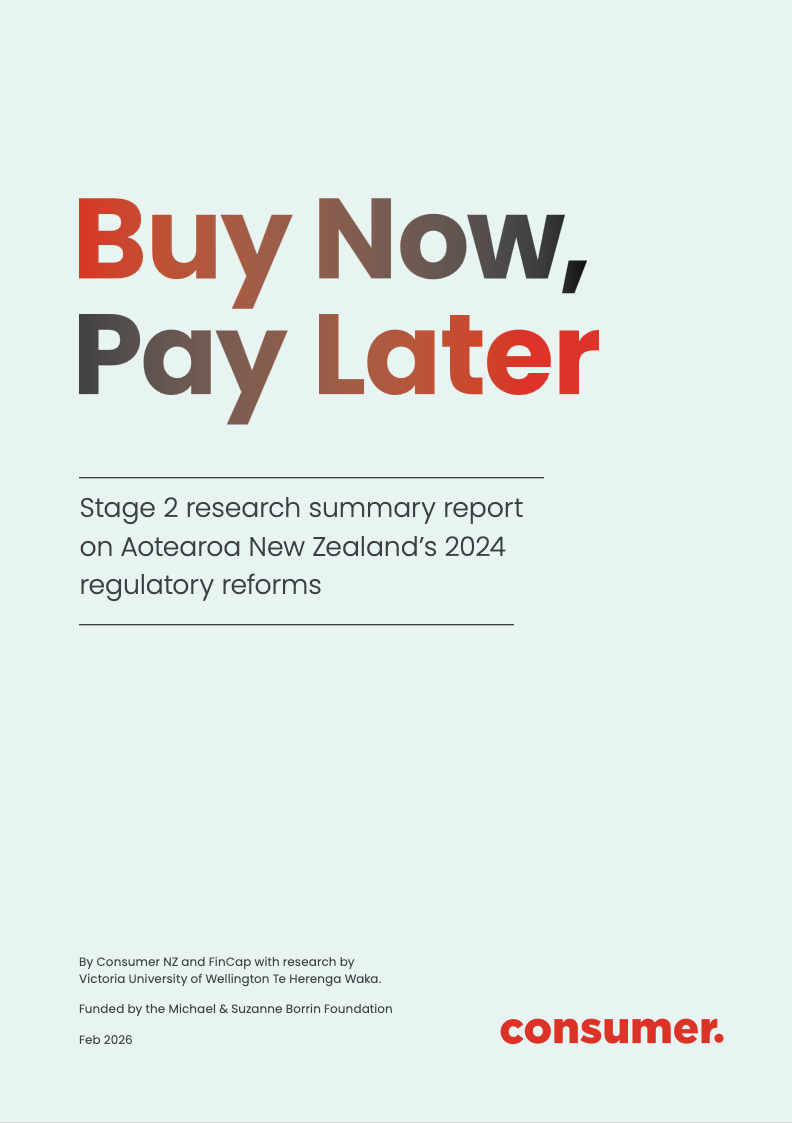
Featured report: Buy Now Pay Later – A critique of the 2024 reforms
Published in February, this report by Consumer NZ and FinCap is the second report in a two-stage research project examining Buy Now Pay Later (BNPL). Stage 2 of the project focuses on the key question: are consumers better protected from the potential harms of BNPL following the September 2024 Regulation?
The report makes a number of important recommendations aimed at strengthening consumer protections and addressing the continuing risks associated with BNPL.
If you are short on time, a summary report is also available.

Podcast series | Somewhere
We’re also pleased to share that we have added a new podcast series to the knowledge library. Created by lawyer Holly Hedley of Dawn Legal and supported by the Michael and Suzanne Borrin Foundation, Somewhere explores trauma‑informed legal practice in Aotearoa.
The series aligns with Waypoint 2 of the Wayfinding for Civil Justice National Strategy, highlighting the importance of understanding and responding to the needs of people affected by trauma.
Upcoming events
If you're aware of upcoming events that you think would be of value to the network, please let us know. If you would like us to advertise your event on our events calendar, please submit it here.
Forum: 2026 International Access to Justice Forum (paid event)
Victoria Law Foundation in partnership with Monash University, Faculty of Law, will be hosting the 2026 International Access to Justice Forum in Melbourne from 28 to 30 October 2026.
Evidence and Action | Bridging the gap between empirical research and person-centred justice.
This three-day gathering will bring together a global community of access to justice leaders to share knowledge, explore new ideas, and work towards practical solutions to improve civil justice.
Early bird registration is now open.
Sector news
New legislation website
The redeveloped NZ Legislation website is now live. The new site includes expanded access to secondary and historical legislation, along with improved features such as mobile‑responsive design, better search and filtering, clearer navigation, and enhanced accessibility.
Feedback is welcome to help continue improving the platform.
AI and access to justice?
A recent RNZ article explores how people are using AI tools to help prepare applications to the Tenancy Tribunal. The piece highlights both potential benefits for access to justice and some of the challenges emerging in practice. Read more here.